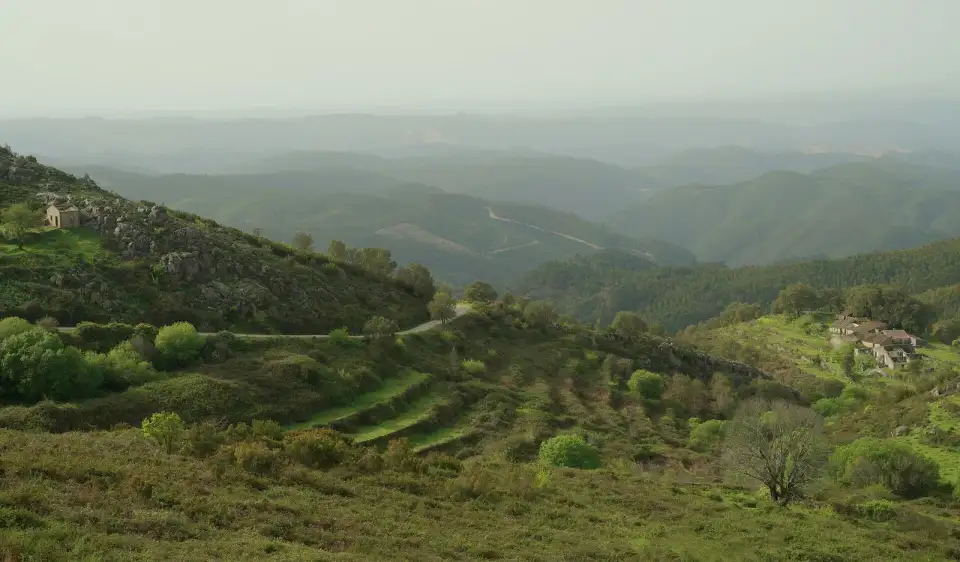
An hour and a half east of Lisbon the country changes completely. The hills flatten into a plain of cork oak and wheat, the traffic disappears, the villages turn white, and in the middle of it sits a small walled town with a Roman temple standing in a square. Évora is the easiest way into the Alentejo, Portugal’s emptiest and least visited region, and it is one of those places that works as a day trip and is considerably better as a night.
What to see in Évora
The Roman temple, standing in the open in the upper town, remarkably complete, free to walk around and lit at night.
The cathedral, fortress-like from outside, with a roof terrace you can climb onto for the view across the tiled roofs and out over the plain.
The chapel of bones, a small chapel whose walls and columns are covered with the remains of thousands of people, assembled by monks as a memento mori. Sombre, striking and quick.
The walled centre, whitewashed lanes with yellow trim, small squares, and a university that has been there for centuries.
The aqueduct, which runs into the town and has houses and shops built into its arches, which is the detail people remember.
The Alentejo around it
This is the region rather than the town, and it is the reason to stay.
Cork oak country. Portugal produces much of the world’s cork, and the stripped trunks along the roads are one of the region’s signatures.
Megalithic sites. Standing stones and stone circles predating almost everything else in the country, out in the fields near Évora, largely unvisited.
Marble towns to the east, built from the local stone down to the pavements.
Wine. The Alentejo is one of Portugal’s major wine regions, and its reds are the everyday drinking of much of the country.
Emptiness. This is the point. The roads are quiet, the horizons are long, and the villages are small and white.
Doing it as a day trip
Take the early bus or train from Lisbon, since the journey is the constraint rather than the town.
Start at the temple and work down through the walled centre.
Cathedral roof next, for the view that explains the geography of the whole region.
Chapel of bones after lunch, since it takes fifteen minutes.
Lunch properly, because the food is a large part of what you came for.
Leave time to wander the lanes without a target, which is what the town is actually for.
Practical notes
It is hot in summer, genuinely, with very little shade on the plain and white walls that reflect the glare.
Spring is the best season, when the plains are green and covered in wildflowers.
Sunday and afternoon closures are taken seriously here, more so than in Lisbon.
Cards are widely accepted and small village businesses may still prefer cash.
Book a restaurant for the evening if you are staying, since the good ones in the centre are small.
How it compares with the other day trips
Sintra is the famous one, closest to Lisbon and the one that needs booking and planning.
Óbidos is the smallest and gentlest, a walled town you can see in an afternoon, covered in our guide to Óbidos.
Cascais is the easy seaside option with a train that runs late, covered in our guide to Cascais and Estoril.
Évora is the longest and the most rewarding, and the only one that genuinely wants a night.
For the city you are leaving and how many days it needs, our Lisbon guide covers the groundwork.
The short version
Take the early bus or train, see the Roman temple, climb onto the cathedral roof, spend fifteen minutes in the chapel of bones and then wander the walled lanes without a plan. Eat properly, because Alentejo cooking is the best value food in the country. And if your itinerary can spare a night, stay: the town empties when the coaches leave, the restaurants fill with locals, and a hire car the next morning opens up the cork oak roads, the standing stones and the wineries that make this region worth more than a day.